The deepest terror of derelict space exploration doesn't come from jump scares or bullet-sponge monsters. It comes from knowing that you are being hunted by something that understands the ship better than you do.
When we set out to build the extraterrestrial threats in Iron Graves, we established a strict design principle: no brainless zombies running in straight lines. The creatures infesting dead starships are apex predators adapted to decades in freezing, pitch-black vacuum. They do not possess omniscient vision; instead, they perceive the world through sound vibrations, light agitation, thermal emissions, and air currents.
In this developer transmission, we pull back the curtain on how we designed and implemented the Sensory Stalking AI System in Godot 4, and how players must use environmental intelligence to survive encounters without firing a single conventional weapon.
1. Sensory Pillar I: Acoustic Tracking & Sound Propagation
Metal hulls are natural acoustic amplifiers. In the cold corridors of a derelict cruiser, every action taken by your drones emits sound waves that travel through connected rooms:
- Drone Propulsion & Footsteps: Gliding on silent low-rpm thrusters generates minimal vibration, but sprinting across metal grates triggers immediate acoustic ripple events.
- Industrial Tool Signatures: Plasma cutters, salvaging torches, and forced pry-bars create loud high-frequency noise spikes that can attract predators from three sectors away.
- Bulkhead Door Cycling: The groaning hydraulics of opening a sealed blast door (
a1 open) send shockwaves through the structural frame.
In our Godot 4 engine implementation, an acoustic listener node evaluates sound loudness against door seals. A heavy sealed blast door reduces transmitted sound amplitude by 85%, allowing clever operators to create decoy noises in quarantined sectors to divert predators away from high-value loot chambers.
[MOTION_DETECTOR_NODE] ACOUSTIC SPIKE DETECTED: SECTOR C-04 (+42 dBm)
[AI_PREDATOR_STATE] INVESTIGATION NODE CREATED AT VECTOR3(14.2, 0.0, -8.6)
[AI_PREDATOR_PATH] CALCULATING DUCT NAVIGATION VIA NavigationServer3D...
[WARNING] TARGET ENTERED OVERHEAD CEILING CONDUIT ABOVE DRONE 02!
> drone2 light toggle off; drone2 thrusters 0%
[STATUS] ACOUSTIC OUTPUT: 0 dB. ENTITY LOST SENSORY LOCK. PURSUIT COOLDOWN: 6.2s
2. Sensory Pillar II: Photophobia & Light Agitation
One of the most intense tactical dilemmas in Iron Graves is the choice of illumination.
Derelicts have been plunged into total darkness for centuries. Organisms thriving inside have developed extreme photosensitivity. Directing your drone's 1000-lumen flashlight beam into a dark cargo bay allows your camera feed to identify salvageable crates — but sweeping that beam across a hibernating bio-colony will instantly agitate the swarm.
Operators must frequently decide:
- Do you pilot in pitch darkness, relying strictly on motion tracker pings and acoustic sweeps?
- Or do you risk flashlights and powered-on overhead floodlights to quickly map room layouts before something notices the glare?
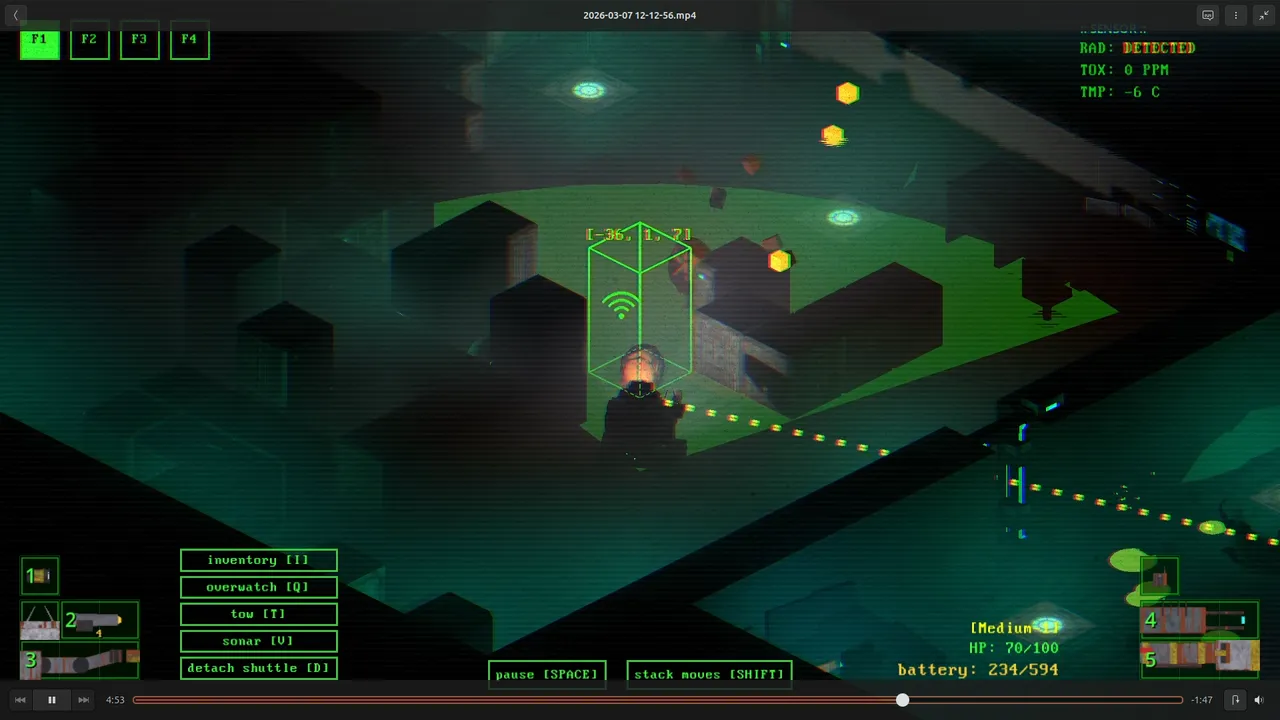 Figure 1: Navigating pitch-black containment corridors — balancing flashlight battery, acoustic pings, and lurker shadows.
3. 3D Verticality: Ceiling Ducts & Blind-Spot Ambushes
Unlike 2D grid roguelites where enemies only traverse standard floor tiles, Iron Graves exploits full 3D volumetric space:
Predators do not just patrol corridors; they utilize sub-floor maintenance crawlspaces and overhead ventilation shafts. If a drone retreats into a corridor and seals the blast door behind it, the creature may climb through an overhead duct and drop silently behind the drone while the operator is busy hacking a computer terminal.
This vertical freedom forces players to monitor 360-degree camera feeds, check ceiling grates for dripping bio-matter, and listen closely to directional audio cues rendered through Godot's spatial sound bus.
4. Containment Tactics: Turning the Ship Against the Beast
Your drones are not heavily armed battle tanks; they are fragile salvage robots. Direct combat is almost always fatal. Your real weapons are the derelict ship's surviving engineering systems:
- Airlock Purging: Lure an apex stalker into an outer airlock with a noisy drone decoy, seal the inner blast door remotely, and cycle the outer valve to blast the monster into freezing space.
- Electrical Barriers (
ShortCircuitFire): Reroute high-voltage power conduits into damaged floor plates to create impassable sparking electrical fire barriers that block bio-infestations. - Vacuum Depressurization: Breaching viewports or hull breaches into infected chambers starves combustible bio-mass and pulls loose debris into quarantine bulkheads.
5. Technical Implementation in Godot 4
To achieve responsive, terrifying predator AI across dozens of procedurally generated rooms without CPU lag, our Godot 4 architecture relies on three core systems:
- NavigationServer3D Multi-Layer Meshes: We maintain separate navigation meshes for floor walking entities and ceiling-crawling stalkers, synchronized in real time as bulkheads open and close.
- Pre-Calculated AABB Sensory Queries: Rather than expensive continuous raycasts, sensory checks use hierarchical spatial queries (AABB sector overlap → conical line-of-sight → acoustic attenuation).
- Modular State Machine: Predators cycle through distinct behaviors: Dormant → Investigating Noise → Stalking Shadows → Ambush Strike → Retreat to Ducts.
6. What Lies Ahead in Transmission #005
In our next transmission, we will reveal Derelict Ship Classes & Lore: From Military Cruisers to Infested Research Arks — the procedural lore generation, distinct environmental hazards, and unique room archetypes that define each salvage contract in Iron Graves.
OPERATOR ACTION REQUIRED: WISHLIST ON STEAM
Every single Steam Wishlist directly boosts our visibility in the algorithm and supports independent sci-fi survival horror. If you're ready to command drones and outsmart extraterrestrial horrors, join the mission today.